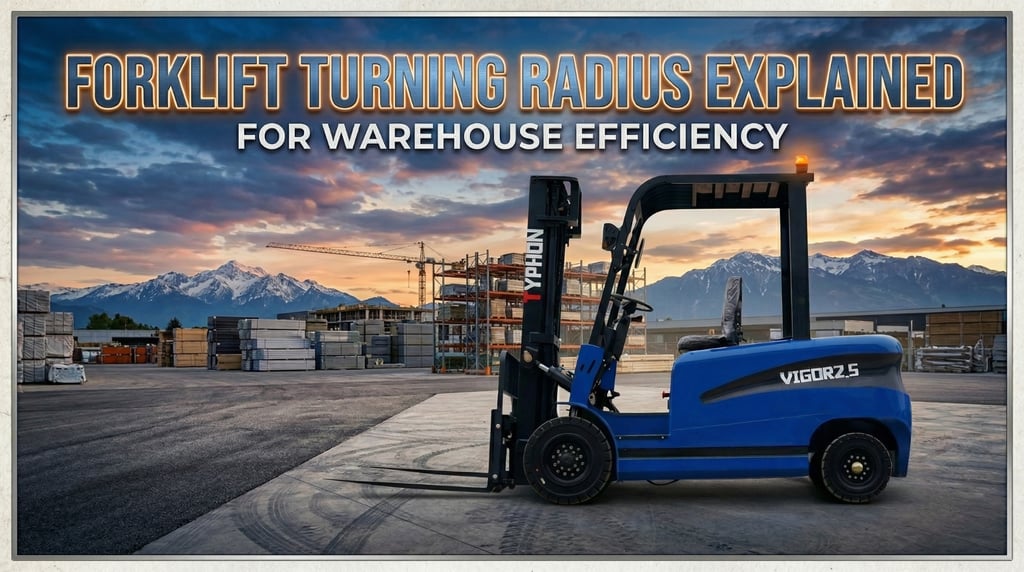
Forklift Turning Radius Explained for Warehouse Efficiency
Learn how mastering forklift turning radius boosts warehouse efficiency, improves maneuverability in tight spaces, and keeps your operations safe.
3/28/20266 min read
Every square foot of your facility represents a significant financial investment. When you optimize that space, you increase your storage capacity, streamline your workflow, and maximize your profitability. However, simply packing more racks onto the floor can quickly create operational bottlenecks if your material handling equipment cannot navigate the layout effectively. The physical dimensions of your machinery directly dictate how efficiently your team can move inventory.
Understanding your equipment's specific spatial requirements is critical for smooth daily operations. One of the most important specifications you must evaluate is the forklift turning radius. This single metric determines whether a machine will glide seamlessly through a narrow aisle or struggle to complete a simple directional change. Ignoring this measurement leads to damaged inventory, structural damage to racking systems, and massive drops in daily productivity.
This guide explores the essential role of forklift turning radius in modern material handling. We will break down the mechanics of rear-wheel steering design and why it remains the industry standard. You will discover how prioritizing maneuverability in tight spaces drastically improves your overall warehouse efficiency. Finally, we will provide actionable strategies you can implement immediately to enhance safety and boost the performance of your entire fleet.
What Is Forklift Turning Radius?
The turning radius is the exact amount of space a machine requires to complete a full 360-degree circle without stopping or reversing. Manufacturers calculate this measurement by turning the steering wheel to its absolute maximum limit and driving the machine in a continuous circle. The distance from the center of that circle to the furthest outside edge of the machine equals the turning radius.
This specification is the foundation of intelligent warehouse design. When facility managers plan storage layouts, they use this metric to calculate the absolute minimum aisle width required for safe operation. If you deploy a machine with a turning radius that exceeds your aisle width, your operators physically cannot retrieve pallets without performing dangerous, multi-point turns.
By utilizing machines with a compact turning radius, you unlock the ability to narrow your aisles safely. Narrowing your aisles allows you to install additional rows of pallet racking across your facility. This simple equipment alignment instantly increases your total storage capacity, maximizing the return on your commercial real estate investment.
The Mechanics Behind Rear-Wheel Steering Design
If you have ever driven a standard passenger car, you know that the front wheels dictate the direction of travel. Material handling equipment utilizes the exact opposite approach. Standard counterbalanced lifts feature a specialized rear-wheel steering design. This engineering choice is not arbitrary; it is a deliberate, highly effective solution for operating in confined environments.
When the steering axle sits at the rear of the machine, the entire vehicle pivots around its front drive wheels. This allows the front forks to swing in a much tighter arc. The operator can guide heavy, cumbersome loads into precise positions with minimal forward travel. If these machines utilized front-wheel steering, they would require massive, wide-open spaces to complete a simple turn.
However, rear-wheel steering creates a unique physical dynamic known as "tail swing." When the operator turns the steering wheel to the left, the rear counterweight of the machine aggressively swings out to the right. Operators must remain acutely aware of this tail swing at all times. Failing to account for the rearward movement frequently results in severe collisions with racking systems, walls, or nearby personnel.
Maximizing Maneuverability in Tight Spaces
High-density storage facilities face constant logistical challenges. You need to move heavy pallets quickly, but you have very little physical room to work with. Overcoming these spatial restrictions requires equipment specifically engineered for extreme maneuverability.
When your machinery features a tight turning radius, operators can approach loads at sharp, aggressive angles. They do not need to back up, reposition, and try again. They simply drive down the aisle, pivot the machine effortlessly, and engage the pallet on the first attempt. This smooth, continuous movement is the hallmark of professional material handling.
Furthermore, exceptional maneuverability in tight spaces reduces the physical and mental strain on your workforce. Navigating a bulky, oversized machine through a narrow corridor is stressful and exhausting. When you provide your team with agile, responsive equipment, they can focus entirely on the task at hand. Comfortable, confident operators consistently deliver higher output and make far fewer mistakes during long shifts.
How Turning Radius Impacts Warehouse Efficiency
Efficiency is the ultimate metric for your operational success. It dictates how many trucks you can load, how fast you can process inbound freight, and how quickly you can fulfill customer orders. The turning capabilities of your fleet influence every single phase of this workflow.
Accelerating Daily Cycle Times
A material handling cycle consists of picking up a load, transporting it, and placing it in its final destination. Every time an operator has to stop, reverse, and correct their angle, they add precious seconds to that cycle time. Over an eight-hour shift, those wasted seconds compound into hours of lost productivity.
Machines with an optimized turning radius eliminate these unnecessary corrections. The operator flows through the workspace, completing smooth turns at the end of every aisle. By removing the physical bottlenecks from your floor plan, you accelerate your cycle times drastically. This accelerated pace ensures your shipping docks remain clear and your outbound freight departs strictly on schedule.
Streamlining Heavy Traffic Corridors
During peak operational hours, your main facility corridors experience heavy equipment traffic. Multiple operators often need to navigate the same intersections simultaneously. Large machines with wide turning circles frequently block these intersections entirely when attempting to change direction.
Compact equipment prevents these traffic jams. A tight turning radius allows an operator to execute a sharp 90-degree turn without swinging into the oncoming traffic lane. Maintaining a smooth, predictable flow of traffic prevents gridlock and keeps your entire workforce moving efficiently.
Prioritizing Safety in Confined Environments
While speed and productivity are vital, they must never come at the expense of workplace safety. Warehouse environments are inherently dangerous due to the combination of heavy loads, moving machinery, and pedestrian traffic. Understanding and respecting the turning dynamics of your equipment is a fundamental requirement for a secure facility.
A machine that requires too much space to turn will inevitably collide with its surroundings. Even a minor collision can compromise the structural integrity of your pallet racking. If a damaged rack collapses under the weight of heavy inventory, the results are catastrophic. You face massive financial losses and place your employees in severe physical danger.
By matching your equipment's turning radius precisely to your layout, you provide your operators with the exact amount of clearance they need to work safely. They can negotiate blind corners and narrow aisles without the constant fear of striking an obstacle. This proactive approach to spatial planning protects your inventory, preserves your infrastructure, and ensures your team goes home safely every single day.
Practical Tips for Improving Maneuverability
You can take immediate steps to enhance how your equipment moves through your facility. By implementing strict operational protocols and making informed equipment decisions, you can optimize your current layout without undergoing a massive facility redesign.
Match the Machine to the Aisle
Never purchase or lease material handling equipment without consulting your facility's exact dimensions. You must calculate your Right Angle Stack requirement. This calculation combines the machine's turning radius, the length of the load, and a required safety clearance buffer.
Measure your narrowest aisles and cross-reference those measurements with the manufacturer's specifications. If your required stacking aisle is 12 feet wide, you cannot deploy a machine that requires 14 feet to turn. Selecting the correct equipment from the start is the most reliable way to guarantee smooth, efficient operations.
Implement Comprehensive Operator Training
Even the most agile machine is useless in the hands of an untrained operator. Rear-wheel steering is highly unintuitive for new employees. You must provide comprehensive, hands-on training that focuses specifically on tight-quarter maneuvering.
Set up obstacle courses using empty pallets or traffic cones to simulate your narrowest aisles. Teach your operators how to calculate their tail swing visually before initiating a turn. When your team fully understands the mechanical geometry of the equipment, they can navigate complex spaces with absolute precision.
Maintain Clean and Organized Aisles
Your equipment cannot utilize its turning radius if the physical workspace is cluttered. An aisle that measures 12 feet across is completely compromised if pallets, shrink wrap, or debris are left sitting on the floor. Obstacles artificially shrink your available operating space, forcing operators to make dangerous, erratic turns.
Enforce strict housekeeping policies across your entire facility. Ensure that all inventory remains securely inside the racking systems and never encroaches on the designated travel lanes. A clean, highly organized floor plan allows your machinery to function exactly as engineered, maximizing your daily warehouse efficiency.
Conclusion
The relationship between your facility layout and your material handling equipment determines the success of your operation. By respecting the critical importance of the forklift turning radius, you empower your business to achieve unprecedented levels of warehouse efficiency. Compact, highly maneuverable equipment unlocks the true potential of your floor space, allowing you to store more inventory and process orders rapidly.
Mastering maneuverability in tight spaces requires a commitment to proper equipment selection, rigorous safety protocols, and ongoing team development. When you prioritize these elements, you build a resilient, highly productive operation that consistently delivers exceptional value to your customers.
Take a walk through your facility this week and carefully measure your most heavily trafficked aisles. Review the technical specifications of your current fleet to ensure your equipment aligns perfectly with those dimensions. By addressing any spatial conflicts immediately, you protect your valuable assets, support your hardworking team, and secure the long-term profitability of your business.
Explore our wide range of mini excavators for sale.
Company
© 2026. New Mini Excavator, All rights reserved.

Privacy Policy | Terms and Conditions
Follow us now
Support
For Inquiries
2522 S Malt Ave. Commerce, CA 90040
United States
Our Location
Tel:
+1-213-214-2203
+1 626-389-2472
Email:
-sales@typhonmachinery.com
-support@typhonmachinery.com